- Recorded
- 27 June 2026
- Quarter
- Near northeast
- Air
- 94 F at the start
- Sky
- White sky, no cloud, no wind
- On foot
- 0.5 miles, about 35 minutes
Record 05
One building, one wall, two trades that share a lunch hour
Not next door. Not across a car park. The same building, divided once, with a kitchen on one side of the wall and a bandsaw on the other.
Seven parcels, the smallest run on this list, and the shortest walk. Two of the seven are one building on one slab.
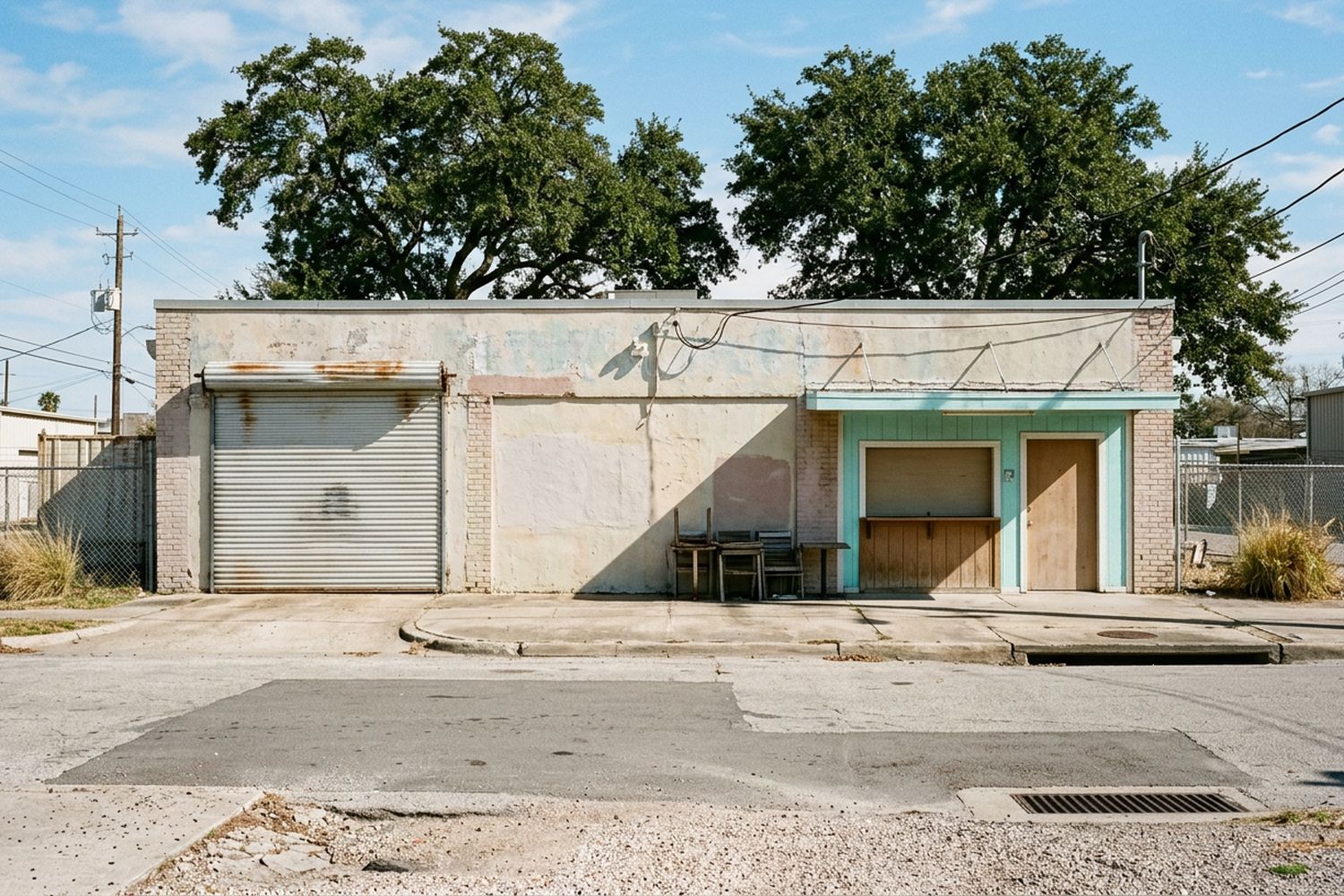
The building is a single storey masonry shed of the kind put up here in the fifties for whatever needed a slab and a roof. It has two doors on the street, about thirty feet apart, and one wall inside dividing it into unequal halves.
The larger half is a metal fabricator. The smaller is a taqueria with six tables. They share the wall, the slab, the roof and, at noon, most of the same customers.
What stands here
The shared building, then a yard with racked steel behind a fence, then two houses, then a car repair shop with three bays and a gravel forecourt. On the far side, three houses in a row and a vacant parcel with a foundation still on it.
The block is small enough to see all of at once, which is unusual and is the reason it is on the list.
Noon
The reason to walk this block is the hour between half past eleven and half past twelve, and the reason to walk it in June is that the heat makes what happens visible.
At twenty past eleven the fabricator's roll up door goes up, which it has not been all morning, and the sound changes. At half past, six or seven people come out of the yard behind it, cross thirty feet of pavement and go through the other door. By quarter to twelve there is a queue of eleven on the pavement, in ninety four degree heat, under a strip of shade that is nine feet deep at that hour and getting deeper.
The shade on the pavement at noon comes from the building's own parapet. It is nine feet deep and it is the only reason a queue can exist here in June.
By half past twelve the queue is gone, the door is down again and the bandsaw is back. The whole arrangement lasts about seventy minutes.
What the arrangement produces
- A customer base that walks. Nobody in that queue drove. In this city that is the rarest sentence in this publication.
- A kitchen that closes early. Half past two, because the trade it exists for has gone back to work.
- Cooking smells inside a workshop, which the fabricator's people mentioned without being asked and did not appear to mind.
- A shared bin arrangement and one shared water meter, which is visible as a single box on a wall that plainly serves two businesses.
- No parking problem at all, because the peak demand arrives on foot from thirty feet away.
Walking it
Pavement on the building side, none on the house side. Both crossings unmarked. Five tenths of a mile round with the return, which took thirty five minutes only because of standing still to watch the noon shift.
Do this one in the morning or at noon, and take water. At two in the afternoon in June this block has no shade anywhere except that parapet strip, and the strip belongs to the queue.
What it tells you
That the strongest argument against separating uses is a lunch queue. The fabricator's people can eat without getting in a car because a map never told the kitchen it had to be somewhere else, and both businesses exist partly because the other one does.
Two trades, one wall, seventy minutes a day of complete dependence on each other. No planner would have drawn it and neither of them would move.