- Recorded
- 21 February 2026
- Quarter
- North side
- Air
- 54 F at the start
- Sky
- High overcast, no wind
- On foot
- 0.6 miles, about 40 minutes
Record 01
A metal shop, eleven bungalows, and fifty years of not moving
The first thing a zoned city would have prevented is the first thing on this block, and the houses next to it are still full.
Fourteen parcels along four sides. Nine of them single family, two commercial, one vacant, two combined into a single yard.
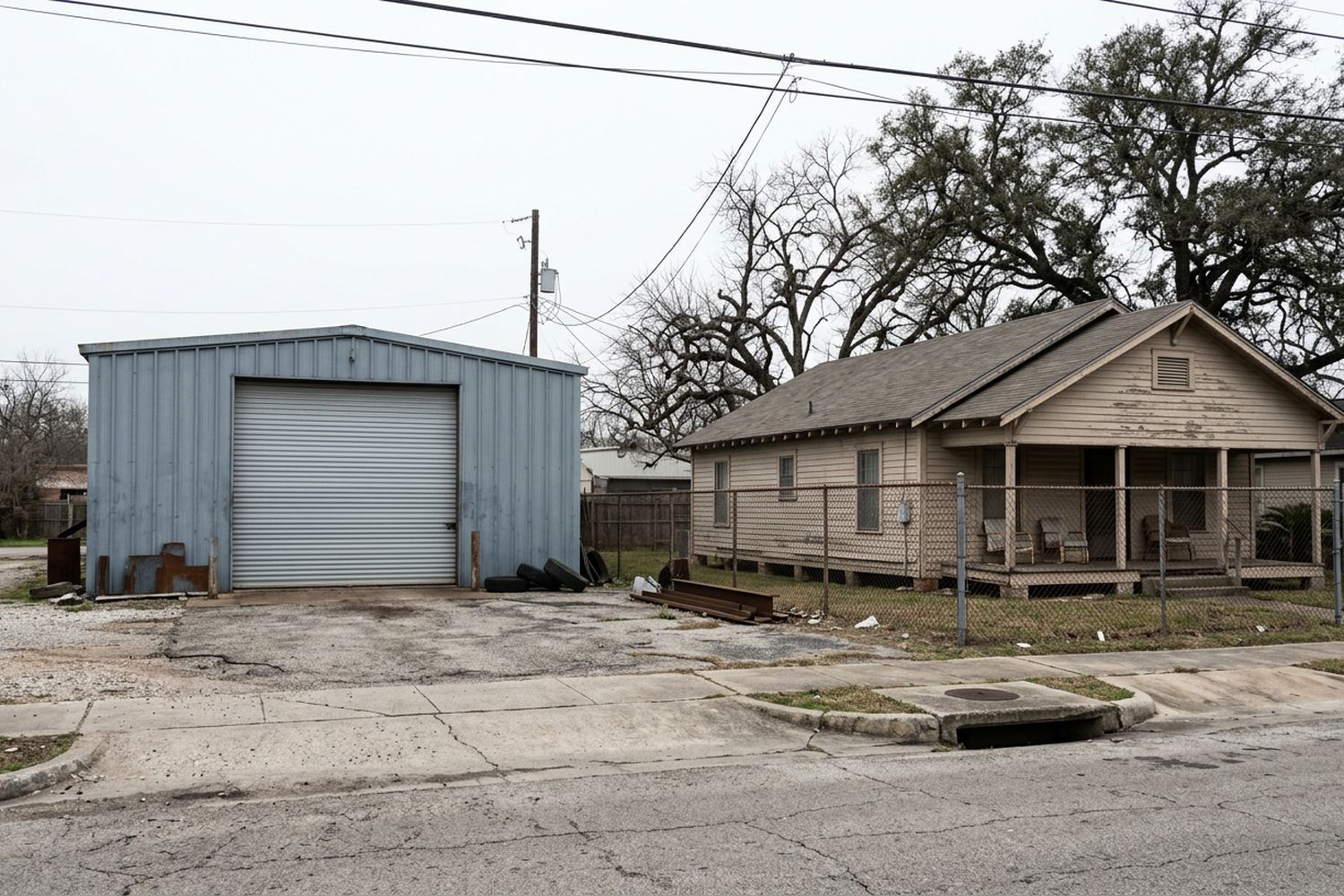
The shop takes the corner. It is a steel building, painted a colour that has stopped being a colour, with a roll up door facing the side street and a compressor that starts twice while you are standing there. Twenty feet from the door, across a strip of grass and a chain link fence, is the front porch of a bungalow.
That sentence is the entire subject of this publication, so it is worth being precise about it. Not across a street. Not behind a buffer. Twenty feet, measured, with a fence in between that somebody put up and somebody else has painted.
What stands here
Going clockwise from the corner: the shop, a yard belonging to the shop with three trailers in it, then nine bungalows in a row of the kind built here in the nineteen twenties, one of them with a second building at the back that is plainly a workshop of its own. Then a vacant lot mowed to the fence line. Then two more houses, then the corner again.
The houses are small, raised on blocks, with deep porches and metal roofs that are newer than everything else about them. Four have window units, five have central plant on a slab beside the house.
The order it happened in
The houses first, in the twenties. The shop building went up in the sixties on what a Sanborn map would have shown as two residential lots. Nobody could stop it, because there was nothing to stop it with.
Deed restrictions cover much of the older city and are enforced privately. On a block where they lapsed, or never existed, the only limit is what the market and the neighbours will bear.
Then, and this is the part that surprises people who have not walked a city like this, nothing else happened. The row did not collapse into industry. The houses did not empty. Fifty years later the shop is still one building on one corner and the row is still nine houses, all occupied, four of them with the same families according to the neighbour who volunteered that while watering.
What the arrangement produces
- Noise on a schedule. The compressor and the grinder run in the morning. By four in the afternoon the loudest thing on the block is a dog.
- Parking, solved sideways. The shop's people park in the yard. Neither side blocks the other, and neither side has a marked space anywhere.
- A fence culture. Every house on the shop end has a fence. The four at the far end have none.
- Shade, unevenly. The house side of the street has three big trees. The shop side has none, because a steel building and a yard do not want them.
- A surprisingly clean street. The shop sweeps its own frontage, which is more than the vacant lot's owner does.
Walking it
Pavement on the house side only, and it stops twice for driveways with no kerb cut. The shop side has a gravel verge and a shallow ditch you would not want to step into in the dark. Circling the block means crossing a road with no signal and no marked crossing.
Sixty hundredths of a mile all the way round with the return. Forty minutes, because you stop.
What it tells you
That the fear a zoning map is built around is mostly a fear of a slippery slope, and on this block the slope did not slip. One workshop arrived, took its corner, and stopped.
The interesting question on a block like this is not why the shop was allowed. It is why nothing followed it.
The honest answer is probably that the houses were worth more as houses than as lots, for fifty years running, and the moment that stops being true this record will be out of date. Which is why the date sits at the top of it.